


How to Find Cheap Flights and Last-Minute Hotels in 2026
Research current as of September 2, 2026
Main Finding and Key Takeaway
There is no single best day or app. No booking day or travel app always finds the lowest price. The best results come from using a simple process and comparing your options carefully.
Use this simple booking system:
- Search several travel dates and nearby airports.
- Use price alerts instead of checking prices manually.
- Compare the full price, not just the advertised base rate.
- Check the airline or hotel website directly before booking.
- Choose refundable options while prices and plans are still changing.
- Use loyalty discounts and points only after reviewing the terms.
- Treat extreme discounts and urgent payment requests as possible scams.
1. Best timing for cheap flights
Historical booking windows
Google analyzed five years of airfare data. Its results provide useful benchmarks, but they are not guarantees for every route.
When to Book Different Types of Flights
These historical booking windows can help you plan your search. They are useful benchmarks, not guaranteed rules. Prices can change based on demand, route, holidays, and available seats.
| Trip Type | Historical Low-Price Range | Average Low Point |
|---|---|---|
| U.S. domestic | 21 to 60 days before departure | About 44 days |
| Thanksgiving travel | 36 to 74 days before departure | About 52 days |
| Christmas travel | 20 to 88 days before departure | About 22 days |
| Spring break, March or April | 23 to 59 days before departure | About 38 days |
| Summer travel, July or August | 14 to 44 days before departure | About 21 days |
| U.S. to Europe | 50 to 179 days before departure | About 129 days |
| U.S. to Mexico or the Caribbean | 37 to 87 days before departure | About 59 days |
Smart booking tip: Start tracking prices before the low-price window begins. Set an alert, compare flexible dates, and book when the fare fits your budget instead of waiting for a perfect price.
Best use of this data: Use these windows as a starting point. Do not wait for the exact “perfect” day if your dates are fixed or the trip is during a major event.
For busy holiday routes, popular concerts, school breaks, and limited-flight destinations, booking earlier usually carries less risk.
The best day to book is mostly a myth
Google found only about a 1.9% average difference between booking on weekdays and booking on weekends.
That is too small to support the old “always book on Tuesday” advice.
The day you fly can matter more. Google found that Monday, Tuesday, and Wednesday departures were about 12% cheaper than weekend departures on average. For domestic flights, the potential difference was about 20%.
These are historical averages. Your route may behave differently.
The best flight strategy
- Search the entire month if your dates are flexible.
- Compare nearby airports.
- Check nonstop and one-stop flights.
- Search one-way flights separately, but only book separate tickets if you understand the risks.
- Set an alert before you are ready to buy.
- Book when the fare is acceptable for your route and dates, rather than waiting for a mythical lowest price.
Google’s own guidance says nonstop flights have been about 20% more expensive than flights with a stop on average. A connection can save money, but factor in the time, baggage rules, and risk of a missed connection.
2. Best timing for last-minute hotels
Hotel pricing is harder to predict than airfare. Rates depend heavily on:
- City and neighborhood
- Events and conferences
- Day of the week
- Hotel occupancy
- Weather
- Season
- Cancellation demand
- Number of rooms left
KAYAK says that for last-minute hotel bookings made within a week of arrival, the cheapest booking point in its data was often about seven days before check-in.
That should be treated as a platform-specific data point, not a universal rule.
A practical hotel timing strategy

If your dates are fixed
Book a refundable room early if the price is reasonable. Then monitor the same hotel and rebook if the price drops.
Check:
- Cancellation deadline
- Whether you pay now or at the hotel
- Taxes and mandatory fees
- Resort or destination fees
- Parking
- Deposit and incidentals policy
- Whether the hotel will honor the lower rate after a rebooking
If you can be flexible
Start comparing prices early. Then check again:
- Around 7 to 10 days before arrival
- Around 72 hours before arrival
- On the day before arrival
Last-minute discounts are more likely when a hotel has unsold rooms. They are less likely during major events, holidays, and sold-out periods.
If you need a room tonight
Compare:
- HotelTonight
- Google Hotels
- KAYAK
- Booking.com
- Expedia
- The hotel’s own website
Then call the hotel’s front desk and ask for the best available rate. The hotel may not beat the online price, but it can clarify room availability, parking, deposits, and fees.
Do not cancel an existing room until the replacement booking is confirmed.
3. Best tools for cheap flights
The Best Tools for Finding Cheap Flights
Each flight search tool has a different strength. Use more than one when comparing prices, but always review the final booking terms before paying.
| Tool | Best Use | Important Limits |
|---|---|---|
| Google Flights | Best overall search, flexible dates, nearby airports, and price tracking | It is mainly a search tool. The airline or booking provider controls the final terms. |
| Skyscanner | Whole-month searches, Cheapest Month, and Explore Everywhere | Prices shown in flexible searches can be estimates based on recent searches. |
| KAYAK | Price alerts, price calendar, nearby airports, and provider comparison | KAYAK does not control the airline or online travel agency’s cancellation and change rules. |
| Going | Curated deal alerts and mistake fares | Best for travelers who can change destinations or dates. It does not search every possible flight for you. |
| Hopper | App-based price predictions and price freezes | Predictions are not guarantees. Price Freeze fees and coverage limits vary. |
| Airline Website | Final comparison, direct support, loyalty credit, and easier disruption handling | The fare may sometimes be higher than an online travel agency. |
Best practice: Use Google Flights or Skyscanner to compare options, then check the airline’s website before booking. Direct booking can make changes, cancellations, and flight disruptions easier to handle.
Google Flights
Google Flights remains the best starting point for most travelers.
Useful features include:
- Calendar view
- Date grid
- Price graph
- Nearby airport searches
- Price history and price insights
- Route alerts
- Specific flight alerts
- “Any dates” alerts
Google says “Any dates” tracking can send alerts when the lowest price for a route drops significantly. It can also send regular updates with available prices when there is no major drop.
Recommended process: Search on Google Flights, then open the airline’s website and compare the final price before booking.
Skyscanner
Skyscanner is especially useful when the traveler has flexible dates or destinations.
Its official tools include:
- Cheapest Month
- Whole Month
- Explore Everywhere
- Route and date price alerts
- Nearby airport comparisons
Skyscanner warns that flexible-date prices are based on recent searches and can change quickly. Use the tool to find patterns, then confirm the current fare before paying.
Want my short list of trusted travel sites?
I use different companies for different parts of a trip. See which ones I rely on for flights, hotels, rentals, and activities.
KAYAK
What KAYAK offers:
- Flight and hotel price alerts
- Flexible flight searches
- Price Calendar
- Price Forecast
- Nearby airport searches
- “Hacker Fares” that combine different airlines
KAYAK says its flexible-date flight search can compare up to three days before and after the selected dates.
KAYAK does not charge an additional booking fee for its search service, but the airline or partner site may apply its own charges. The provider that issued the ticket controls refunds, changes, and cancellations.
Going
Going is useful when the traveler is flexible about the destination and wants curated alerts.
Current U.S. membership pricing reported on Going’s official pages:
Going Membership Plans
Going offers several membership levels for travelers who want curated flight deal alerts. The best plan depends on how flexible you are with destinations, travel dates, and cabin class.
Limited
Free
Main benefit
Occasional economy deals, mainly for the continental U.S.
Premium
$49 per year
Main benefit
Domestic and international economy deals, plus custom destination alerts.
Elite
$199 per year
Main benefit
Premium features, plus premium economy, business, and first-class deals.
Keep in mind: Membership prices and features can change. Check the current plan details before subscribing.
Going is not a replacement for Google Flights. It is better viewed as a deal-alert service.
Hopper
Hopper focuses on mobile price predictions, price freezes, and flexible booking options.
A price freeze may let a traveler hold a fare for a limited period. However:
- The fee is generally nonrefundable.
- It may not count toward the final booking price.
- Coverage can be limited to a stated amount.
- The fee, time period, and protection limit vary by offer.
The FTC’s 2026 case against Hopper’s operators resulted in a reported $35 million settlement over allegations involving hidden fees and misleading claims about VIP Support and Price Freeze services. The FTC case page says the settlement prohibits misleading claims about fees, total prices, and these services.
That does not mean every Hopper booking is unsafe. It does mean travelers should read the final payment screen carefully and avoid assuming that “price freeze” means a full guarantee.
4. Best tools for last-minute hotels
The Best Tools for Finding Last-Minute Hotels
Each hotel booking tool serves a different purpose. Compare more than one option, then review the cancellation policy, total price, and booking provider before paying.
| Tool | Best Use | Important Limits |
|---|---|---|
| Google Hotels | Price comparison, hotel-specific alerts, and basic price history | Google does not handle most changes or cancellations. |
| HotelTonight | Same-day and very late hotel bookings | Most rooms are nonrefundable and non-cancellable. |
| KAYAK Hotels | Comparing hotel prices and setting alerts | The booking partner controls the reservation. |
| Booking.com | Wide inventory and flexible-cancellation filters | Cancellation rules come from each property. |
| Expedia | One Key member pricing and package searches | Member discounts exclude taxes and fees. |
| Hotels.com | One Key member rates and price guarantee options | Rewards, fees, and price-match eligibility have restrictions. |
| Hotel Website | Loyalty benefits, direct support, and a clearer relationship with the hotel | The direct rate is not always the lowest. |
Best practice: Use comparison tools to find available rooms and possible savings. Before booking, check the hotel’s own website and compare the complete price, cancellation terms, loyalty benefits, and payment conditions.
Google Hotels
Google Hotels is a strong comparison tool because it lets travelers review multiple booking providers for the same property.
Current features include:
- Hotel-specific price tracking
- Destination-level hotel tracking
- Price comparisons across providers
- Hotel details, ratings, and location information
Google does not normally act as the hotel or booking provider. For cancellations or changes, Google directs travelers to the hotel or online travel agency shown in the reservation.
HotelTonight
HotelTonight is designed for same-day and short-notice stays.
Its official FAQ says:
- Rooms can be booked up to 100 days in advance.
- A room can generally be booked until 2 a.m. during the first night of the stay, based on local time.
- Some hotels assign the room type at check-in.
- Most bookings are nonrefundable, non-cancellable, non-transferable, and non-modifiable unless different terms appear at checkout.
HotelTonight also has an HT Price Guarantee. Depending on how far in advance the booking is made, the claim window can be:
- Two hours for same-day bookings
- Until midnight for next-day check-ins
- 24 hours for bookings more than one day ahead
The guarantee compares the same hotel, dates, and room type. The credit generally covers the room-rate difference, not taxes and fees.
Use HotelTonight when you need a room quickly and can accept strict terms. Do not use a nonrefundable booking if your plans may change.
Booking.com
Booking.com says cancellation fees are set by the property.
The property may offer:
- Free cancellation
- Partial refunds
- Nonrefundable rates
- Pay-at-property options
- Prepayment or deposits
The exact cancellation deadline appears during booking and in the confirmation.
Booking.com’s Genius rates are available at participating properties. A Genius discount is not a universal discount on every hotel or date.
Expedia and Hotels.com
Expedia’s One Key program offers logged-in members 10% or more off eligible stays in its current U.S. member-price promotions. Expedia states that taxes and fees are excluded from this discount.
Eligible members can also earn OneKeyCash. Expedia reports different earning rates for different travel products, so travelers should check the current offer before assuming a fixed return.
Hotels.com also offers Member Prices on selected properties and dates. Its price guarantee can match an eligible lower price in OneKeyCash, rather than providing a direct cash refund. The current Hotels.com page also limits eligibility for some members based on when they joined One Key.
5. Fees that can destroy a “cheap” deal
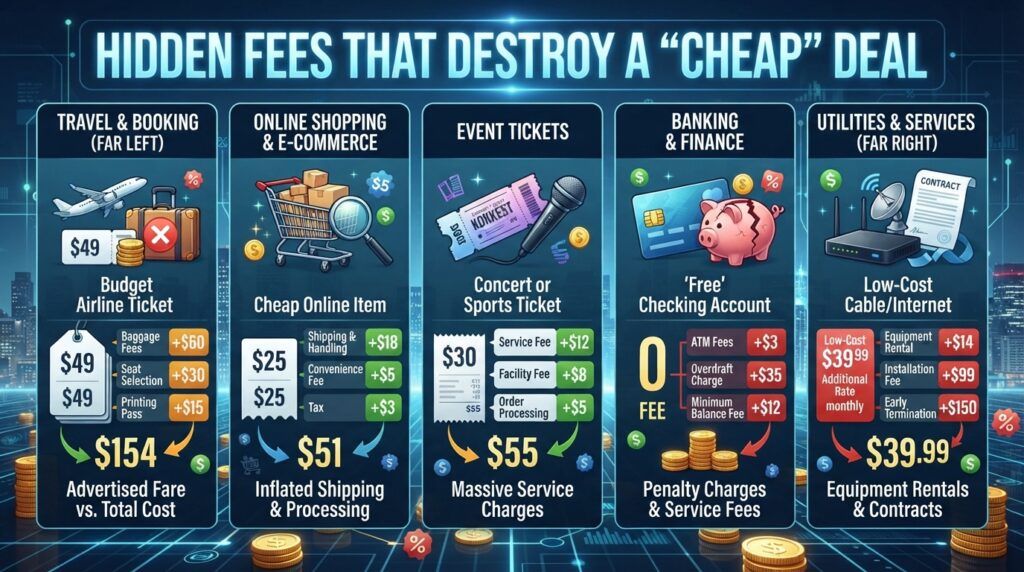
Flight fees
Always compare the final cost after adding:
- Checked baggage
- Carry-on baggage
- Seat selection
- Priority boarding
- Change or cancellation protection
- OTA service fees
- Payment or currency charges
The U.S. Department of Transportation requires airlines and ticket agents to disclose certain baggage fees clearly with the fare quotation.
The DOT’s 24-hour rule is also important. When a ticket is purchased at least seven days before departure, an airline must generally offer either:
- A 24-hour cancellation option with a full refund, or
- A 24-hour fare hold without payment
This rule does not apply in the same way to tickets bought through online travel agencies. Booking directly with the airline makes this protection easier to use.
Hotel fees
Compare the total stay price after adding:
- Resort or destination fees
- Parking
- Taxes
- Cleaning fees
- Extra-person fees
- Pet fees
- Deposit requirements
- Early check-in or late check-out charges
The FTC’s Rule on Unfair or Deceptive Fees took effect in 2025 and covers short-term lodging. Covered sellers must show the total price upfront, including mandatory fees they know about and can calculate.
The rule does not ban resort fees. It requires covered businesses to present mandatory fees clearly instead of hiding them until the final payment screen.
A good comparison is:
Total price for the entire stay, including mandatory fees, divided by the number of nights.
Do not compare a hotel’s nightly base rate with an OTA’s all-in rate.
6. Loyalty programs and points
Airline loyalty
Free airline accounts can help travelers:
- Earn miles
- Store trip details
- Receive targeted offers
- Use award availability
- Manage disruptions more easily
For award travel, flexibility matters more than the number of miles. A low-mileage ticket with a strict cancellation rule may be worse than a slightly more expensive award that allows free cancellation before departure.
American AAdvantage’s current terms, for example, state that wholly unused award tickets can have miles reinstated when canceled before departure and before the ticket expires. Partially used or expired awards may not qualify.
Policies differ by airline and fare type. Always check the exact award and fare rules before transferring credit-card points.
Hotel Loyalty Programs: Direct Booking vs. Travel Portals
The cheapest booking option is not always the best value. Compare the rewards, support, flexibility, and benefits you receive from each booking method.
Useful Hotel Loyalty Programs
- Marriott Bonvoy
- Hilton Honors
- World of Hyatt
- IHG One Rewards
Compare Your Booking Options
Travel Portal Booking
- Extra credit-card points
- A statement credit
- OneKeyCash
- Package savings
Direct Hotel Booking
- Better hotel loyalty recognition
- Easier changes
- Direct hotel support
- Clearer cancellation handling
7. Common travel scams
The FTC’s 2026 travel warning highlights several scams that target people searching for cheap flights and hotels.
Common Travel Scams to Watch For
Cheap travel offers can sometimes hide a scam. Check the website, payment method, and booking details before sending money or personal information.
1 Fake Airline and Hotel Websites
Scammers copy brand names, logos, and booking pages. These fake websites may appear in paid search ads or use a lookalike domain.
Protection steps:
- Type the airline or hotel website address yourself.
- Check the domain name carefully.
- Avoid booking through an unexpected text or email link.
- Compare the contact information with the company’s official website.
2 Fake Customer-Service Accounts
Scammers monitor social media for posts about flight delays or cancellations. They then pretend to be airline representatives and ask for personal details.
They may request:
- Booking numbers
- Phone numbers
- Login details
- Payment information
3 Dangerous Payment Methods
The FTC warns about travel offers that require payment through methods that are difficult or impossible to reverse.
Be cautious if asked to pay by:
- Wire transfer
- Gift card
- Cryptocurrency
- Payment app
- Cash or cashier’s check
4 Fake Vacation Rentals
Scammers may copy a real rental listing or invent a property that does not exist.
Before paying:
- Search the property address.
- Search the owner or company name.
- Check whether the property appears on the company’s official website.
- Look for duplicate listings with different owner names.
- Avoid moving the transaction away from the trusted booking platform.
5 Vague Luxury Offers
Be cautious when an offer promises a “five-star resort” but does not provide basic booking details.
Look for:
- Exact hotel name
- Street address
- Travel dates
- Cancellation rules
- Total price
- Company name
8. Recommended 2026 booking workflow
Your 2026 Flight and Hotel Booking Workflow
Use these steps to compare prices, reduce surprise costs, and protect yourself when booking a trip.
For Flights
- Search Google Flights.
- Use the date grid, price graph, and nearby airports.
- Cross-check the results on Skyscanner or KAYAK.
- Set a price alert for your route.
- Check Going if the destination is flexible.
- Open the airline’s website before booking.
- Compare the full price, including baggage and seat costs.
- Review the cancellation and change terms.
- Pay with a credit card when possible.
- Save the confirmation and fare rules.
For Hotels
- Search Google Hotels and KAYAK.
- Compare Booking.com, Expedia, Hotels.com, and the hotel website.
- Check the full price for the entire stay.
- Confirm the cancellation deadline.
- Look for a refundable backup room.
- Sign in to check member pricing.
- Compare loyalty benefits with travel portal rewards.
- Recheck prices around seven days, 72 hours, and 24 hours before arrival if your plans are flexible.
- Use HotelTonight to check same-day inventory.
- Verify the confirmation directly with the hotel.
Final reminder: Before paying, compare the total cost and review the cancellation rules. A cheaper booking is not always the better deal if it has strict terms or extra fees.
Most Reliable Sources for This Article
Use primary sources for travel rules, fees, booking policies, and current product features.
Official government agencies, airlines, hotels, and booking platforms should be your first stop when checking current travel information.